by Marian George Isaac
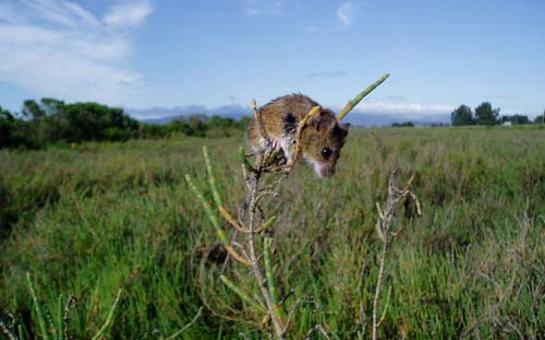
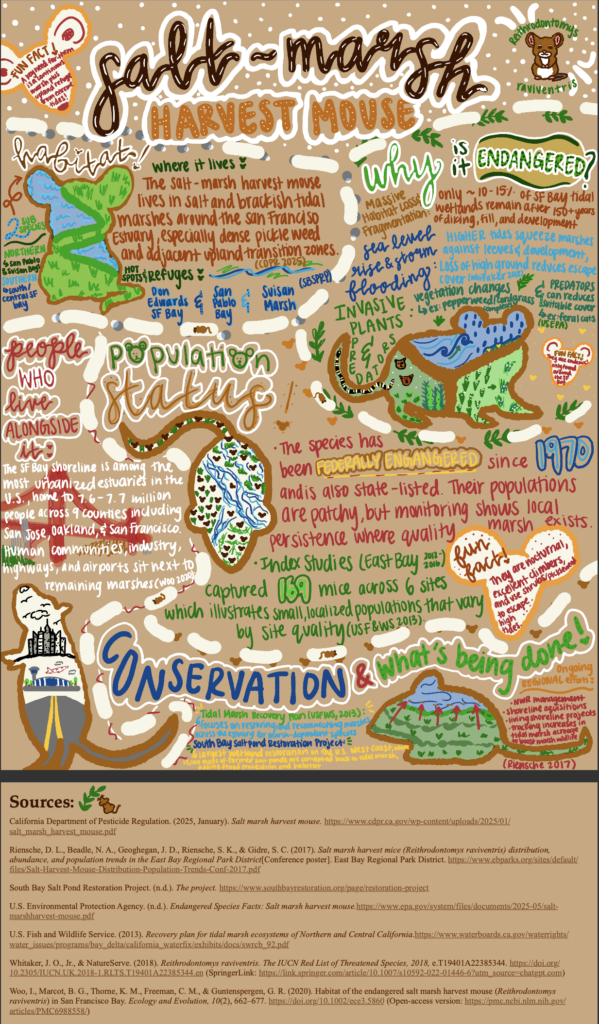
I’m Marian, an undergrad at UC Berkeley double majoring in Molecular and Cell Biology and Integrative Biology, with a minor in Disability Studies. During my conservation biology course project, I drew an infographic on the salt marsh harvest mouse, a tiny but mighty endangered species native to the tidal marshes of the San Francisco Bay.
I was inspired to choose the salt marsh harvest mouse for my project as it is a phenomenal example of how smaller sized animals can play a crucial role in conservation. I was drawn to growing my knowledge about the species due to its unique habitat and its connection to California wetlands. The rodents’ survival is notably intertwined with and connected to the overall health of salt marsh ecosystems, which sparked my interest in learning more about the species.
While constructing the infographic, I delved deeper in exploring a plethora of ways that the salt marsh harvest mouse relies on the tidal marsh habitat, as it contains areas with dense vegetation which serve as a source of food, cover, and flood protection. The species faces threats primarily from habitat loss, development, and rising sea levels. Protecting one species means protecting an ecosystem as a whole. Wetlands are essential for wildlife and help to support biodiversity. They improve water quality and protect communities nearby as well.
This project helped me to think deeper about the communication of science. I was driven to take intricate scientific information and organize it in a format that would be clear, visual, and most importantly accessible to the public. I focused on making the infographic educational without being overwhelming. Keeping in mind that I wanted readers to be able to quickly grasp why the salt marsh harvest mouse matters and why its habitat is in need of protection, I illustrated information through various methods. It was incredibly interesting to learn how specialized this rodent is to its marsh environment. Though it might be very small in size, it represents the much larger story of conservation. Its survival certainly depends on careful habitat management and restoration. Public awareness also bolsters their chance of survival.
I hope that readers find my infographic inspiring, helping them to learn more about endangered species as well as the habitats they reside in. Conservation can feel like a dense topic at times; however, delving deeper into learning about a certain species is a great place to start. To better protect wildlife and their ecosystems, small actions can be taken to help. These actions include supporting the restoration of wetlands and respecting areas that are protected. Sharing educational resources and staying informed are also good actions to take.
Through developing this infographic, I came to truly appreciate the work that many refuge biologists and conservation professionals do on a daily basis. It reminded me that science is not only about gathering information, but it is absolutely about helping others understand why that information matters.