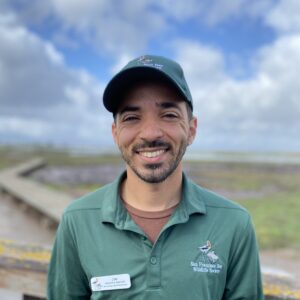
 By former SFBayWS Interpretive Associate Joe Montes de Oca
My time with the San Francisco Bay Wildlife Society was short but filled with excellent company, new experiences and lasting memories. Working as a high school Italian and Portuguese teacher for eight years in Miami helped me learn to manage a classroom and keep students engaged, but working for the SF Bay Wildlife Society gave me the opportunity to cover topics nearer and dearer to my heart, and with a wider audience. Talking about and pointing out nature’s beauty, importance and our impacts and how we can make a difference is something I had never been able to do regularly prior to joining the SFBWS. Needless to say, my passion for biodiversity and for recognizing our role as humans in protecting and preserving something so precious was something I couldn’t help but put on full display when helping lead a field trip, a bioblitz, while tabling or during one of our public programs.
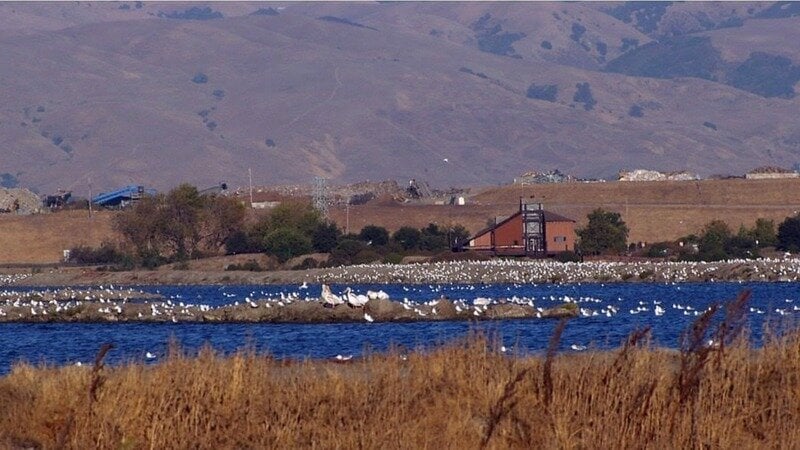
Learning about the salt marshes of the San Francisco Bay and the other habitats of the Don Edwards San Francisco Bay National Wildlife Refuge was something I jumped right into early on. I worked closely with Sirena and Leila to also learn about the two critical projects in progress on and around the Refuge: the South Bay Salt Pond Restoration Project and the South San Francisco Bay Shoreline Project. The restoration work underway is nothing short of amazing and I was glad to be one of the many people sharing why so many organizations have gotten together to recognize the value of salt marshes. What these habitats create for wildlife is, in my opinion, valuable enough to merit preservation and protection, but the ecosystem services they naturally provide to us are essential in a warming climate with more and more sea level rise on the horizon.
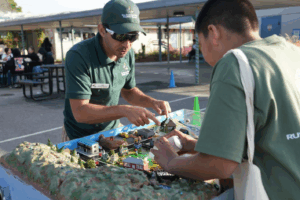
Joe showing a child the watershed model. Photo: Russo McEntee Academy
The Santa Clara Valley Urban Runoff Pollution Prevention Program (SCVURPPP) was the funding source for my position, so a big part of my work included making people aware of their connection to the San Francisco Bay. I had seen storm drains and their signs mentioning how water flows to the Bay, but I learned a lot more about pollution sources and how we can eliminate them. I had the opportunity on several occasions to table with Leila, Sirena and Erika with our fantastic watershed model. It is a magnet for kids and adults alike, and it was always fantastic seeing light bulbs go off as people understood the concept of stormwater runoff pollution and how to prevent it. I have always tried to walk the walk when it comes to being environmentally conscious, but it was nice to have a platform to also talk the talk and emphasize how important our daily actions are in determining our future.
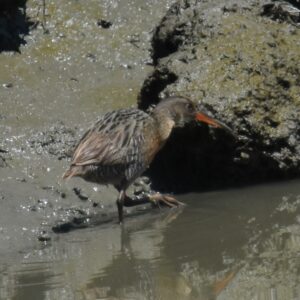
Ridgway’s Rail seen during a field trip for Newark Memorial High School. Photo: Joe Montes de Oca/SFBWS
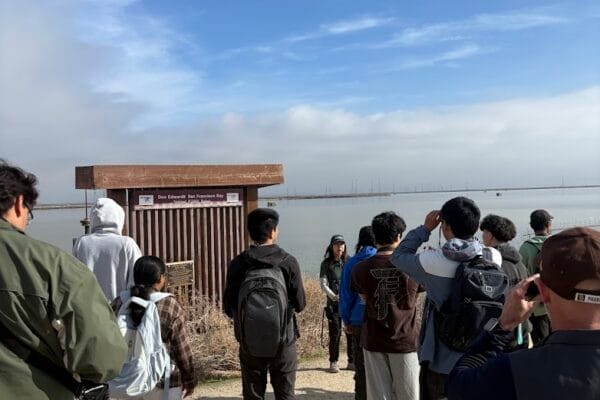
It’s hard to limit specific highlights from my seven months working at the EEC because there was always something fun or exciting going on. College field trips were always a blast: meeting the students, TAs and professors and hearing the fantastic questions come up as we walked the refuge made each one unique and memorable. Heading to the Fremont Headquarters on several occasions also stood out as being special. Riding the bus with Marsh-In campers from George Mayne Elementary and then seeing how much fun they had across the three days of camp under the direction of the Habitat Heroes was something I won’t forget anytime soon! Newark High School also came to HQ for two days of field trips organized by Tia (USFWS) and I was lucky enough to spot my lifer Ridgway’s Rail while leading a small group of students. I had my camera with me and was able to get some photos of this elusive bird walking along the exposed mud during low tide. I doubt many of the students had ever seen someone get so excited about seeing a bird!
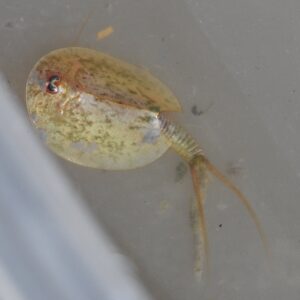
Vernal pool tadpole shrimp at Warm Springs. Photo: Joe Montes de Oca/SFBWS
Speaking of rare/endemic species, joining Aidona (USFWS) and a couple other volunteers to conduct surveys for vernal pool tadpole shrimp and California tiger salamanders was nothing short of magical. These creatures go through incredible life cycles and I felt honored to participate in such important scientific work. Shadowing Aidona and Destiny during plant surveys near the peak bloom period a month later was the icing on the cake in terms of experiencing the beauty of the refuge’s vernal pools! Another highlight was presenting on moths and getting a good array of species on our sheets outside the EEC Pavilion during our Moth Week event. I spent several nights mothing on the refuge across a couple months before the presentation to get an idea of what we could expect and really enjoyed that experience as well. Lastly, I’d be remiss if I left out the time I got peed on by a bat roosting inside one of the EEC bat boxes while I was trying to get a photo from below!
Needless to say, the San Francisco Bay Wildlife Society has taught me many things and the fact that it was my first job in California means I will always associate it with my first time living away from my hometown. 2025 has been a special year for me and I will always look back fondly on my time with SFBWS. I am grateful to Sirena, Mary, Leila, Aja, Erika, Tia, Aidona, and so many other folks who were kind and helpful! I also worked with several volunteers across multiple programs/events. Laurel, Mike, Larry, and Ken have inspired me to also donate time to support both the SFBWS and FWS. Getting out to the Don Edwards San Francisco Bay National Wildlife Refuge to do more exploring, especially as more parts of the refuge are opened up post-restoration work is also on the menu for me. I know I will continue seeing everyone around so this is not a goodbye, but a see you soon!
Joe Montes de Oca was the Interpretive Associate for the San Francisco Bay Wildlife Society. Before moving to the Bay Area in January 2025, he worked as both a field researcher in Everglades National Park and a high school Italian and Portuguese teacher. He brought his passion for documenting biodiversity and conservation to his work with the Society. When he isn’t teaching in the classroom, you can find him exploring both wild and urban spaces, snapping photos of plants, birds, insects, and any other organisms he can find.